Road Base Calculator: What a Camp Lane Takes in Crushed Gravel
Enter your project dimensions
Stone laid straight onto the loam that was already there will pump mud up into itself by the second spring, and no depth setting in this road base calculator can prevent that. Strip the organic layer first. Everything below follows from what is left underneath.
What the bar tells you before any measuring
Push a probe down where the lane will run, in several places, and note two things.
How wet it stays. Dense till with hardpan under it holds water. A sand terrace along a river valley sheds it. The same lane can cross both in a hundred feet.
Where the ledge is. Granite near the surface means you build up rather than dig down, and the depth you type becomes the height of stone above the rock, with the shoulders shaped to run water off.
Then there is the calendar. Base work runs from the end of mud season into late fall, later in the North Country than in the southern towns, and frozen ground will not compact at all. Ordering in March for a lane that cannot be rolled until May is how a pile ends up sitting through the wet.
Frost is not something depth defeats. It reaches roughly 48 inches down south and 60 or more in the north, far below any lane base. What keeps a surface intact through the thaw is drainage under it and honest compaction on the way in.
Depth on soft ground and depth on a dry terrace
Enter the depth you want after rolling, not the depth of the excavation.
| Traffic and ground | Compacted depth |
|---|---|
| Light residential, firm subgrade | 4 inches |
| Regular vehicles and delivery trucks | 6 inches |
| Soft or wet subgrade, parked equipment | 8 to 12 inches |
On wet or weak ground, woven geotextile between soil and stone stops the two from mixing. It is not sold here, so pick a roll up locally before the stone arrives.
Add depth before you add width. A narrow lane built deep survives; a wide lane built thin breaks at the wheel tracks first.
Centerline for a lane, corner to corner for a pad
A lane that bends gets measured down the middle of the driving surface, with an average width rather than the widest point. Pace it; do not take it off a plan that was drawn before the trees came out.
A pad is simply length by width, plus whatever overhang you want past the thing standing on it.
The form takes a shape first: rectangle, circle for a round turnaround, or multiple areas if the job is several pieces, up to five of them totaled into one figure. Length, width and diameter are in feet. Depth is in inches and accepts 0.25 up to 24. The material select is what sets the weight, so choose it before reading the tons.
The box marked 10% for compaction and spillage starts ticked and is worth leaving on for any base order. Results come back as cubic yards, tons and cubic feet, and Email my quote sends them in writing.
Three thousand pounds to the yard, which is the heavy end
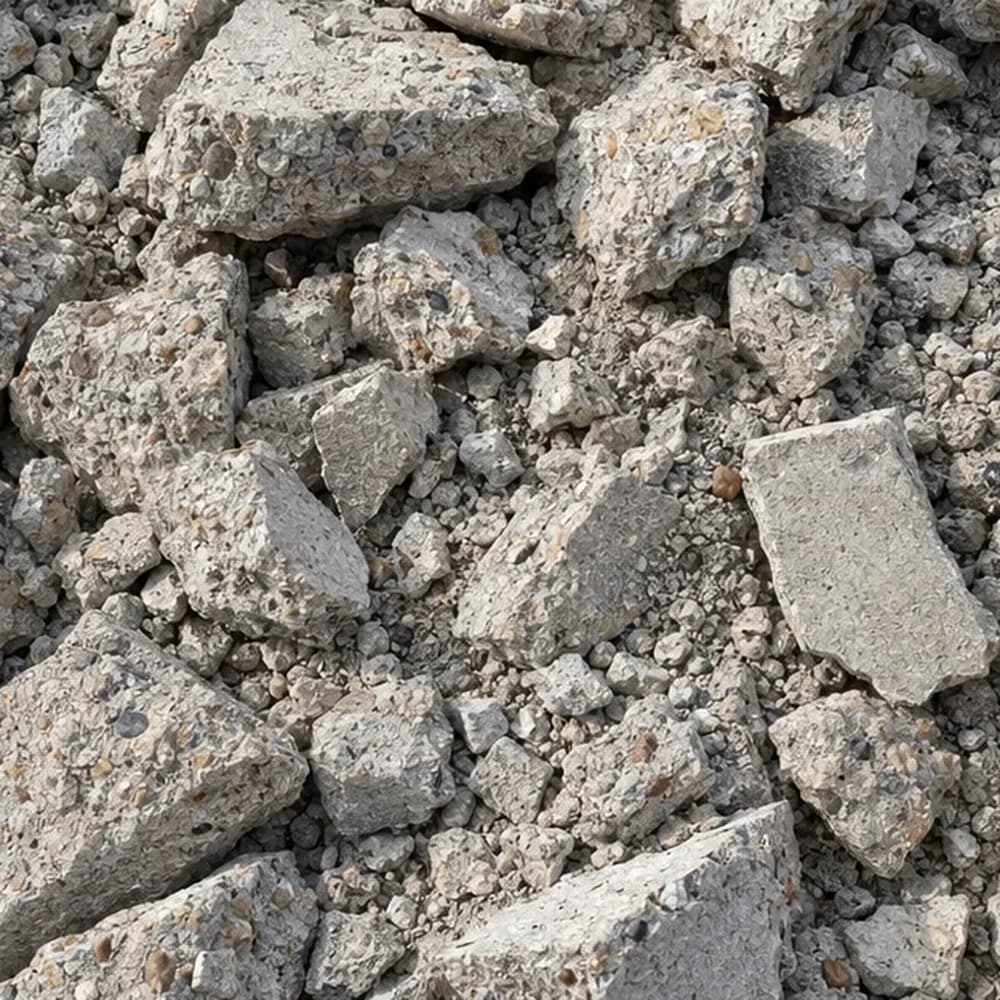
Crushed gravel and crusher run share the heaviest row on this site: about 3,000 lb per cubic yard, or 1.50 tons. The fines fill the voids that clean stone leaves open, which is both why it weighs more and why it locks up under a roller.
Cubic yards = length ft x width ft x depth in, divided by 12, divided by 27. Tons = cubic yards x 1.50.
For comparison, clean stone such as 3/4 inch crushed stone runs about 2,800 lb per yard, or 1.40 tons. Same hole, lighter load.
Locally the base material is crushed gravel, which NHDOT specifies as Item 304.3. That item number is how the material is described on plans around here, not a certification held by this storefront.
Crusher run is the finer, closer-graded relative of it. Coarser stone carries load, so crushed gravel goes under lanes, yards and pads. Finer material grades smoother, so crusher run suits flatwork bases and close finish grading. Either compacts. They are sized with the same arithmetic, and the crusher run calculator handles that side.
A 160 foot camp lane, and a pad for a container
Both hypothetical, both worked out longhand.
The lane
One hundred and sixty feet of lane at 12 feet of running width, 6 inches compacted.
- 160 x 12 = 1,920 sq ft
- 1,920 x 0.5 ft = 960 cu ft
- 960 / 27 = 35.56 cu yd
- 35.56 x 1.50 = 53.33 tons
- With the 10% box ticked: 39.12 cu yd, 58.66 tons
Fifty tons will not go down in one layer. Place it in lifts of 4 inches or less and roll each one before the next arrives on top.
The pad
A shipping container, 10 by 22 feet, at 8 inches with fabric underneath.
- 10 x 22 = 220 sq ft
- 220 x 0.667 ft = 146.67 cu ft
- 146.67 / 27 = 5.43 cu yd
- 5.43 x 1.50 = 8.15 tons
- With the 10% box ticked: 5.97 cu yd, 8.97 tons
A container puts its whole weight on four corner castings, so it gets the deeper section even over ground that looks perfectly sound in August.
Crown it, then keep a ton back
Set a 2 to 3 per cent fall from the centerline out to both edges. Water that runs off the surface is water that is not sitting in the base through a freeze.
Where a smooth, low-dust driving surface matters, finish over the base with #57 stone or driveway gravel and run that top course as its own calculation.
Round the order up rather than down. Half a ton left over fills the ruts that appear after the first wet autumn, and a lane that comes up short means moving material twice. Spreading twenty tons by shovel takes a week; a box blade or a skid steer does it in an afternoon.
With the tonnage settled, open the product page, set a quantity and a date, and delivery is arranged at checkout by ZIP code. The truck wants firm ground and clear room to tip, which the delivery page covers. If the last stretch in is soft, say so through contact before booking.
Common questions
A round pad for a tank or a turnaround. How does that go in?
Circle mode, and the diameter is the widest distance straight across it, in feet. If you want the area on paper, halve the diameter, square it, and multiply by 3.14. A 14 foot circle is 153.9 square feet, which at 6 inches is 2.85 yards and 4.28 tons.
Fifty tons is a lot to take on trust. Is there a rough check?
There is. At 6 inches compacted, a ton of this material covers about 36 square feet. Divide your area by 36 and you should land within a ton of what the screen shows. The 1,920 square foot lane above gives 53, which it does.
Six inches of crushed gravel and six inches of #57 over the same lane, and the tonnage differs. Why?
Weight per yard. Crushed gravel carries fines and runs near 3,000 lb a yard; clean #57 is nearer 2,800. Identical volume, different load on the truck, so pick the material in the dropdown before you read the ton figure.
Is the 10% allowance enough for a lane this size?
It covers handling and the spill either side of the pile, not the consolidation of a deep base. On a long lane, order to your finished depth, leave the box ticked, and still expect to come back with a couple of tons after the first winter. Engineered work follows its own specified compacted depth instead.
Half the run goes uphill. Does that change the length I put in?
It does. Pace the tape along the driving surface itself rather than taking the figure off a plan, since a climb covers more ground than it looks like from below. Where the pitch is steep enough to make a loaded truck spin, put the deeper section at the foot of it, where the wheels work hardest.
Related calculators
Thirty tons. Zero delivery fees.
Road base priced per ton, hauled free, at lane quantities where hauling usually costs the most.